


Path to Scaling Solid Oxide Coatings

Abstract/Executive summary
One of the tasks of PilotSOEL project is to evaluate the mass scalability of the solid oxide electrolyzers. One of the key components for the stack is the Interconnector Plate (IC). The IC plate usually made from high grade stainless steel has to survive and perform with minimal degradation in very harsh environment [1–4]. Because of the high stack operations temperatures and exposure to hydrogen, oxygen, water steam in high operational temperatures various chemical and physical changes of the plate can occur. These changes are crucial as the movement of elements from the plate towards the cell, for example Cr migration, poisons the whole electrolyzer and its performance drops significantly. Therefore, protective coatings should be used to prevent the interactions between IC plate and the cell itself [5–7]. The efficiency of the protective coatings, especially Mn based spinel oxides have been reported in D3.3.
The coatings for the IC plate within the PilotSOEL project were made by magnetron sputtering. The advantage of this method is density of the coated layers and its scalability. The process parameters are described in detail in D2.2. We will use these parameters as inputs to calculate the potential throughput of an inline coater and make estimations about OPEX and CAPEX when moving to mass scale production, with the aim of achieving cost of 1 EUR per coated plate.
Mass production with magnetron sputtering
The extremes of the scalability of magnetron sputtering have been shown by the architectural glass coaters. These machines can be up to 100m long and more than 3 meters wide to coat 6x3 glass panes with multilayer coating designs [8]. Such coaters are usually placed very near the glass manufactures to avoid shipment of the large glass sheets. Additionally, there are also mid-sized coaters for glass, photovoltaics and telescope mirrors in the market, that also highlight the scalability, but with coater and component sizes more relevant to the project [9].
There are several reasons why one would like to go for a big inline coater. The length of the machine is one of the main talking points when discussing a coater: longer coaters hold more magnetron positions resulting in higher overall deposition speed that is crucial for mass production. In addition, the more cathodes one can have the longer production runs can be maintained. Typically, the glass coaters, for example, run for 1 to 3 weeks 24/7 between maintenances. To have weeks of nonstop production one needs a lot of sputtering material, therefore the more targets inside the coater, the longer the production runs can be.
When thinking about the width of the coater it is again advantageous to go big. This time it is linked to the magnetrons themselves. Since the magnetic field behind the target must have closed loop the magnets at the ends of the magnetron have to be aligned to close the field. This results in weaker field at the ends of the magnetron and introduces uniformity – there is less material sputtered at the ends of the cathode. Depending on the magnetron design the length of the uneven sputtering zone can be up to 10cm. This means that for 1m long target 10cm from each end are not usable (the uniformity will drop significantly). That is 20% of the 1m long target unused, for 2m targets that would be 10% and so on [10,11]. The width, length, number of magnetrons in the system of course directly influencing the cost of the inline coater. Bigger coater is more expensive, but it comes with bigger throughput. Therefore, these parameters must be carefully studied.
Another area to address when designing the inline system are the magnetrons themselves. It is common to see planar magnetrons in research or small-scale coaters, however for large volume production it is beneficial to go for cylindrical magnetrons (Fig.1). The main benefit of the cylindrical magnetrons over planar ones is the sputtering yield, it is possible to sputter 80-90% of the target material out of cylindrical magnetron compared to ~30% that can be achieved with standard planar setups [12]. The targets themselves are slightly more expensive for the cylindrical systems, and the initial cost is higher. The planar magnetrons can be mounted directly onto chamber walls and stationary connection of cooling water and electricity is required. In case of cylindrical magnetrons, special end-blocks are required that rotate the target, ensure cooling water circulation and electrical contact. The benefit of the sputtering yield is greater than the initial costs when moving to mass scale production.
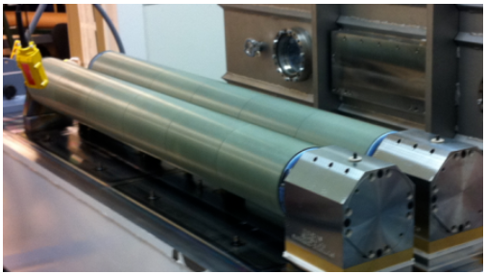
Figure 1 left - dual cylindrical magnetrons with end-blocks [13] ; right planar target with prominent racetrack.
Operational and equipment costs
To calculate the operational and equipment costs we will have to make several assumptions about the scaling process. We will base the calculations on the coatings made for the project, the cost of the raw materials and the operation of the coater is based on the Inline coater used by Naco. For this part we want to see whether or not we can make a business case with the target of the project – 1Eur for coated plate. Here we will use the model made in University of Ljubljana and the model itself will be described in the corresponding deliverable.
We assume here a rather expensive coater and only the minimum number of workers for the coater to be run. The electricity price is based on prices for Latvia. The model takes into account inflation rate of 2%, profit tax of 20%, yearly increase of maintenance cost of 1%. All details will be described in the corresponding deliverable in work package 6.
The result of this model that we will focus on in this deliverable is the Cash flow present value – the indicator that shows can you become profitable and at what time. The result is plotted in figure 4.

Figure 4 Cash flow present value for 15-year period.
As can be seen with the assumptions for the mode one would brake even – start to make profit after 8 years even if the coater costs 50 milj. Eur and the plates are sold for just 1 Eur. The exact price of such machine is hard to predict at this stage. The profits in the end outweigh the investment, this means there is room to build the company as there would be more employees that would add to the costs of daily operations. Besides the salaries an important parameter is the consumables and the electricity – here is a room for improvement with such high consumptions and possible price reduction can be agreed with target manufacturers. Additionally, it is possible to recycle non-precious metals from the coating process, but it doesn’t not make fiscal sense unless we are considering several tons of material. With such throughput as described above one would reach this threshold and could further reduce the price of consumables.
Conclusion
By going to really large quantities of coated IC plates it is possible to make business case with the aim of the price for one sold IC plate to be 1 Eur. The key parameters that will influence the cash flow are the cost of the equipment, the salaries for the workforce and the cost of electricity and consumables. The automation of the handling of the IC plates and coting process would result in higher initial investment but will keep the operational costs lower, as less employees will be required in the long run. The cost of electricity and the CO2 footprint will depend on the country where the coater is being run, as it was shown in D6.1 the magnetron sputtering is ‘green’ if the source of electricity is from renewable resources.
PilotSoel project Results
Comments